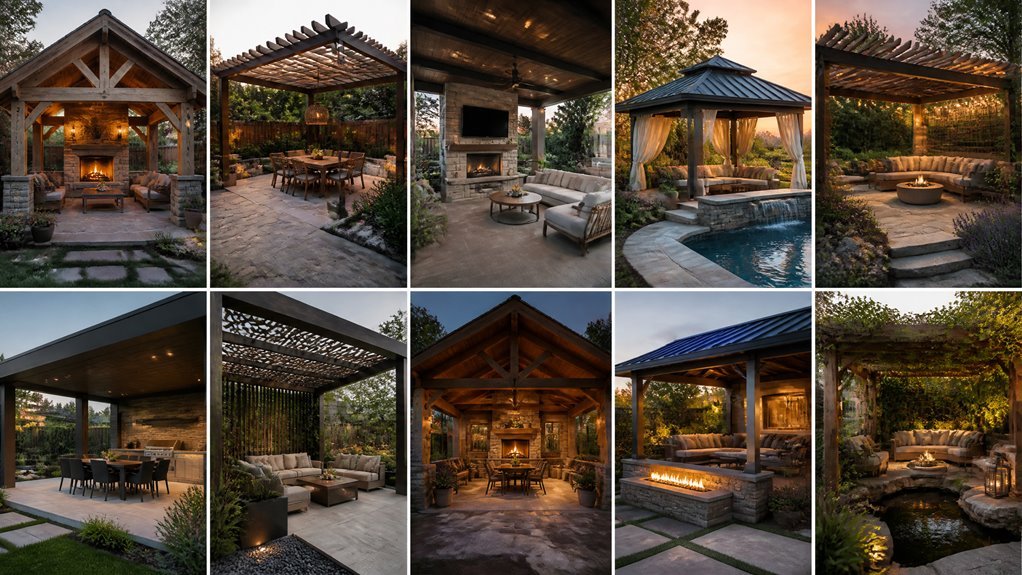
I’ve spent years refining outdoor spaces, and I’ve learned that the most transformative covered patios emerge from understanding exactly how you’ll live beneath them. Whether you’re working with $300 and a weekend or architecting a permitted development with automated louvres, the right structure turns transitional square footage into genuine sanctuary.
My approach balances breathable shade sails against insulated panels rated for year-round use, always measuring twice: a 10-by-12-foot polycarbonate roof delivers rain protection without sacrificing 80% light transmission.
The question isn’t which patio cover looks finest; it’s which one extends your morning coffee, your evening gatherings, your quiet hours outdoors, starting now, starting here.
Budget First: Covered Patio Covers Under $500
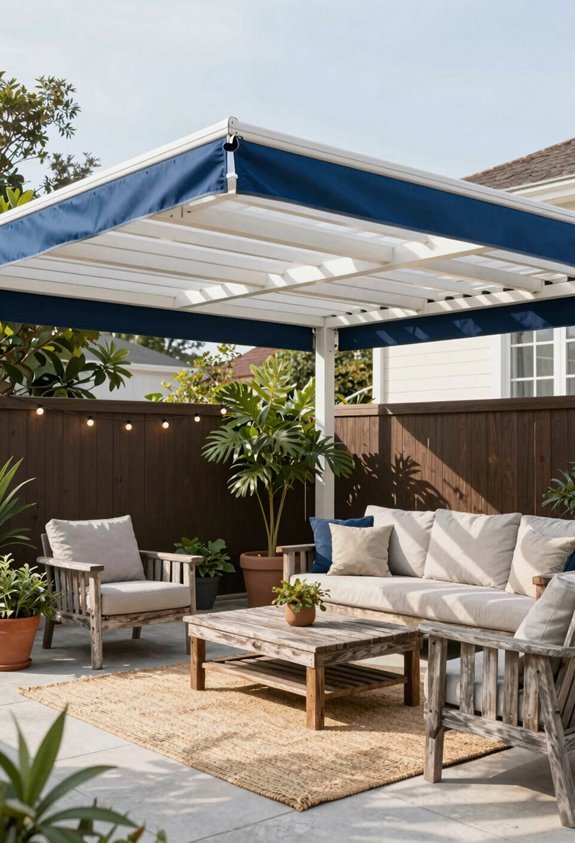
Why should sheltering your outdoor space demand a fortune it cannot spare? I believe everyone deserves a shaded retreat without draining their savings, and I’ve discovered that budget-friendly patio covers under $500 change modest backyards into welcoming sanctuaries where neighbors gather. Seeking belonging starts with inviting spaces anyone can create.
Stretching less than $500, lightweight outdoor curtains, resilient patio umbrellas, and basic fabric canopies shade intimate areas measuring roughly 10 by 10 feet. I recommend using existing walls or railings, eliminating professional installation costs while preserving aesthetic cohesion. These cost-conscious options deliver privacy and dappled shade through breathable polyester or canvas barriers, though I acknowledge their limitations: diminished wind resistance, fabric degradation after two seasons, and negligible rain protection.
Selecting affordable materials like powder-coated aluminum poles or UV-treated polyethylene, you’ll craft refuge without permits, forever changing weekend afternoons into shared, sun-dappled memories.
Shade Sails: The Cheapest Weekend DIY Covered Patio
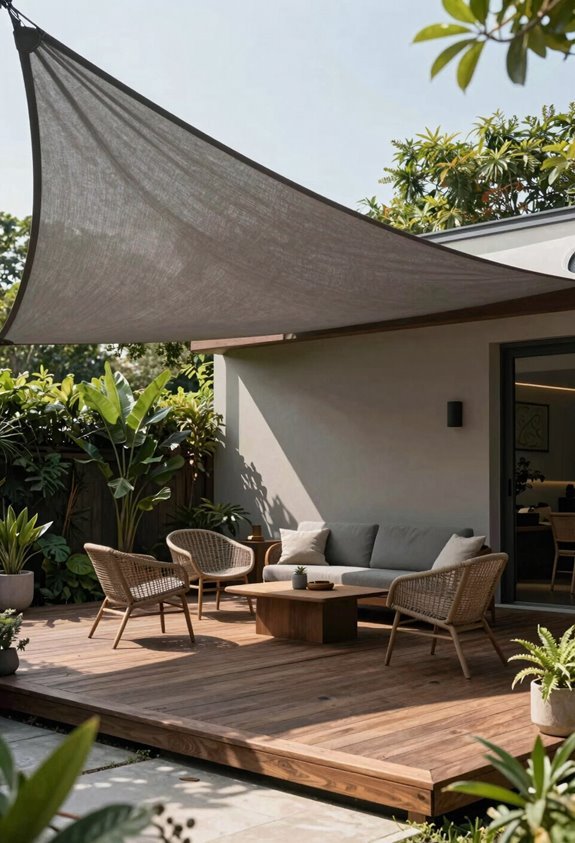
How quickly can a few bolts of fabric transform an exposed slab into a sculptural canopy? I’m convinced shade sails deliver that effect for anyone craving instant outdoor belonging without draining savings. These triangular or rectangular stretched membranes, anchored between pressure-treated posts or existing walls, sculpt dramatic overhead planes that feel intentional yet approachable.
I love that this DIY project welcomes beginners. For roughly $200–$400 and a Saturday afternoon, I’ve watched friends stretch breathable high-density polyethylene across measured points, tensioning corners until the fabric sings taut. The result reads contemporary gallery installation rather than backyard afterthought.
Granted, I’m transparent about limitations. Standard shade sails shed sun admirably yet surrender to rain; wind ratings rarely exceed 35 mph, and that crisp geometry softens within three to five seasons. Still, for accessible change demanding zero permits, this remains unbeatable.
Retractable Awnings: Covered Shade Without Construction
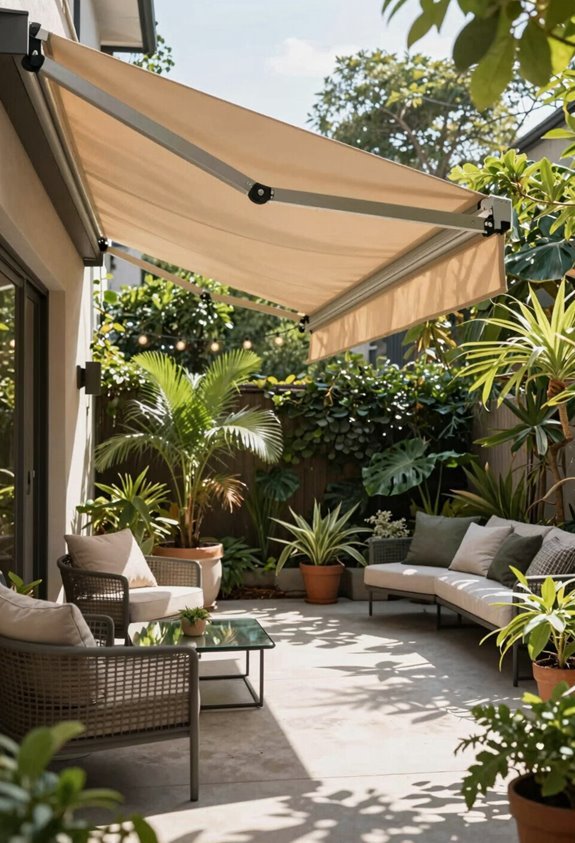
I appreciate how retractable awnings deliver covered shade without the permitting headaches of permanent construction, mounting directly to your home’s exterior with folding arms that extend at the touch of a button. You’ll find the quick installation process remarkably straightforward compared to building a roof structure, often completed in a single afternoon by professionals who secure the housing to wall studs and connect motorized systems with wind sensor safety features that automatically retract the fabric when gusts exceed 25–30 mph.
While the woven acrylic fabric won’t withstand heavy rain and degrades slowly under UV exposure, the ability to adjust your coverage throughout the day, from full sun to partial shade to complete retraction, offers a flexibility that fixed structures simply cannot match. Quality motorized systems typically range from $2,000 to $7,000 depending on width and feature sets.
Wind Sensor Safety
Where retractable awnings distinguish themselves in modern patio design is through intelligent automation that protects both the investment and the atmosphere we’ve cultivated outdoors. Wind sensors convert these systems from simple shade providers into vigilant guardians of our outdoor spaces, automatically retracting the fabric when gusts approach the 25–30 mph threshold that marks their structural limit.
This seamless responsiveness means I’m never anxiously monitoring weather apps or rushing home to secure my patio; the technology preserves our gathering space without demanding constant attention. For those of us seeking effortless elegance, these sensors remove the vulnerability of forgetting an extended awning during sudden storms.
The integration of wind sensors into retractable awnings represents that rare convergence of practical protection and refined living we all deserve in our outdoor retreats.
Quick Installation Process
Why commit to weeks of construction when shelter unfolds within hours? Retractable awnings transform attached patios through remarkably quick installation, mounting directly to your home’s exterior without foundations, permits, or structural modifications.
Professional teams typically complete the process in two to four hours, securing the housing unit to wall studs and calibrating motorized arms with wind sensors for seamless operation. You’ll spend $200 to $2,000 depending on width, fabric grade, and automation features; far less than permanent construction.
Extending outward on folding arms, these systems create instant refuge where we gather, adjusting with afternoon light or retracting for starlit evenings. For those of us seeking belonging beneath open skies without the burden of building, this efficiency delivers architectural presence through intelligent engineering rather than enduring disruption.
Partial Sun Control
How might we command the sun’s trajectory without surrendering to permanent structure? Retractable awnings elegantly answer this call, mounting discreetly to our home’s exterior and extending outward on folding arms to offer precise shade control at the touch of a button.
Motorised options with remote operation or wind sensors, typically triggering retraction at 25–30 mph, grant us effortless command over our outdoor environment without permitting development or construction costs. Best suited for house-attached patios rather than freestanding arrangements, these systems install quickly at prices notably below full roof solutions, inviting us into flexible seasonal living.
We’ll note the fabric’s non-waterproof nature and eventual UV degradation, yet for affordable, adaptable sun management, retractable awnings deliver refined practicality.
Lattice Pergolas: Classic Charm With Dappled Light
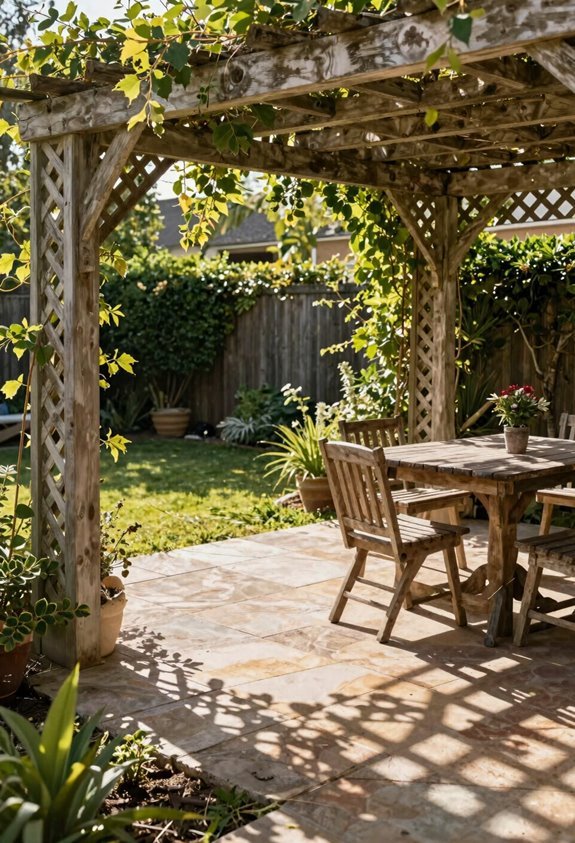
When I imagine the ideal transition between open sky and sheltered garden, I picture lattice pergolas arching overhead with their interlaced beams casting an ever-shifting tapestry of light across stone pavers. These wooden structures define your outdoor room without walls, inviting you into a space that breathes.
| Wood Type | DIY Cost Range | Lifespan with Care |
|---|---|---|
| Pressure-treated pine | $1,000–$2,500 | 10–12 years |
| Cedar | $3,000–$5,000 | 12–15 years |
| Redwood | $4,000–$6,000+ | 15+ years |
I find the dappled light irresistible; sunbeams fracture through the crisscross pattern, nurturing ferns and climbing roses below while painting shadows that move with the hours. You’ll invest annual effort in staining or sealing against rot and insects, yet this rhythm of care deepens your connection to the space.
Train wisteria overhead, and your lattice pergola evolves into something living, layered, and unmistakably yours.
Polycarbonate Roofs: Rain Protection That Keeps It Bright
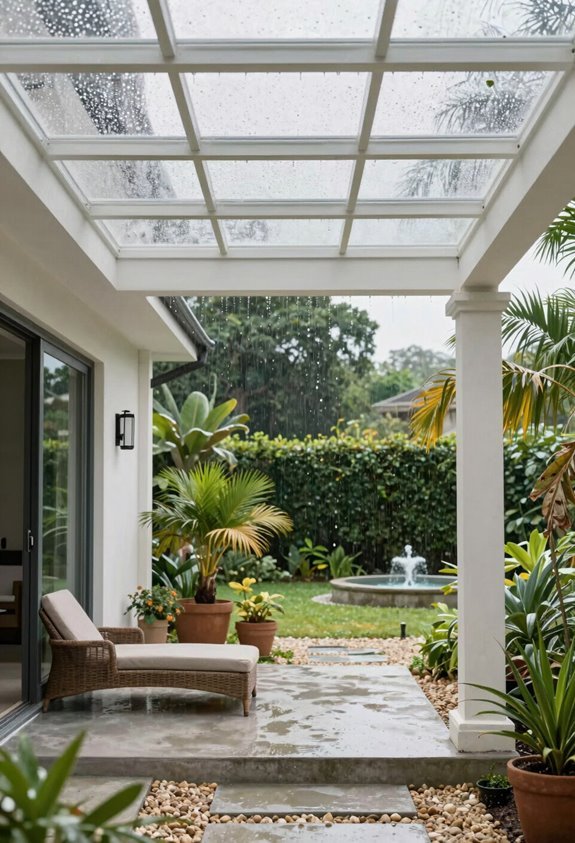
Where sunlight meets shelter, polycarbonate roofing offers a compelling middle ground, transforming your patio into a luminous haven that defies grey skies without surrendering warmth. I’ve watched countless homeowners discover how these panels deliver rain protection without the cave-like dimness of opaque coverings, choosing translucent, frosted, or tinted varieties that bathe gatherings in soft, diffused light.
Multi-wall polycarbonate, twin-wall or triple-wall construction, creates insulating air channels that moderate temperature while scattering illumination evenly across your space. Weighing considerably less than glass, these panels invite confident DIY installation, with 10’x12′ kits running $1,500–$3,000 and professional-grade projects typically spanning $1,000–$4,000 total. You’ll want proper framing and weather-tight mounting, whether you tackle it yourself or enlist expertise.
Mind potential yellowing and greenhouse heat; shade treatments preserve that welcoming brightness we crave for years of shared moments beneath.
Solid Roof Pergolas: Full Weatherproofing Year-Round
Why surrender your outdoor space to seasonal abandonment when a solid roof pergola offers uncompromising refuge through every storm? I’ve watched homeowners reclaim their entire year by choosing fixed aluminum or polycarbonate panels that turn outdoor areas into usable extensions of their homes. These patio cover solutions provide complete weatherproofing without the complexity of motorized systems, costing substantially less while demanding virtually no maintenance. You’ll sacrifice direct sunlight, gaining instead a darker, more enclosed atmosphere that some find cozily protective, others merely dim.
For rainy climates, this trade-off makes perfect sense: uninterrupted durability, simple installation, and year-round usability. I recommend solid roof pergolas when you prioritize protection over transparency, knowing you’ll gather beneath shelter regardless of what falls from above.
Insulated Patio Covers: Outdoor Rooms You Can Actually Use
Solid roof pergolas certainly shield you from the elements, yet I’ve found their single-layer construction limits what a true outdoor room might become; insulated patio covers elevate that shelter into something far more livable. Installing insulated patio panels creates temperatures up to 20°F cooler while delivering full rain protection, a finished ceiling aesthetic, and support for fans, lighting, and shelving across a 20-30+ year lifespan.
For year-round living in hot climates, I’ve watched these permanent structures turn neglected patios into actual extensions of home, though you’ll sacrifice skylight openness and need permits plus professional installation. Expect $4,000–$15,000 for the roof system, with panels running $8–$15 per square foot; a typical 12×16-foot configuration generally totals $6,000–$12,000 including frame and labor.
Louvered Pergolas: Sun or Shade at the Press of a Button
How often have you wished for sunlight during morning coffee yet craved complete shelter by the afternoon? With louvered pergolas, I don’t choose between open sky and protected comfort; I simply press a button and watch aluminum louvers rotate 130 degrees, transforming my pergola canopy from a sun-drenched retreat to a waterproof sanctuary.
I appreciate how quality systems withstand 200 mph winds and 65 psf snow loads, while integrated gutters silently channel rain away. The remote and smart controls let me adapt to shifting weather without leaving my chair, and the aluminum construction promises decades of reliable performance.
For our gathering spaces, louvered pergolas offer unmatched flexibility: morning light for reading, afternoon shade for dining, evening shelter when storms arrive. This is adaptive outdoor living, refined for the way we actually inhabit our backyards.
Vine-Covered Pergolas: Living Roofs for Natural Covered Patios
Where sunlight once poured unchecked across my patio, I’ve cultivated something softer: a vine-covered pergola that breathes with the seasons, its wooden beams gradually disappearing beneath layers of jasmine and wisteria until I’m seated beneath a living ceiling of fragrance and filtered green light.
This living roof delivers increasing shade as vines mature, with evergreen varieties sustaining continuous coverage through warm months. I select jasmine and wisteria for their intoxicating perfume, though I’ve learned rigorous pruning prevents weight stress from compromising my pergola’s structural integrity. Regular maintenance isn’t burdensome; it’s meditative participation in something evolving.
The living roof changes mere shelter into sanctuary, merging landscape with architecture until boundaries dissolve. You’re not simply installing shade; you’re growing belonging itself, weave by intentional weave.
Mix-and-Match Covered Patios: Combining Covers for Perfect Results
I love how layered cover combinations let me craft distinct outdoor rooms without building a single monolithic structure, pairing a 12-by-14-foot cedar pergola over my dining area with a retractable awning shading the adjacent lounge. Hybrid shade solutions like these, mixing fixed louvred roofs with fabric canopies or integrating a screened porch beside an open patio, give me precise control over sun, rain, and airflow while keeping material costs between $8,000 and $25,000 depending on coverage spans and permitted development allowances.
Layered Cover Combinations
Why settle for a single roof style when I’m crafting a patio that must serve so many purposes throughout the day? I layer cover combinations, perhaps a louvered pergola arcing over my dining area, a solid polycarbonate canopy shielding my outdoor kitchen, and a retractable awning unfurling above my lounge chairs, to weave together shelter that shifts with my hours. This layered cover approach lets each zone breathe independently while the whole patio remains visually unified, wood grain playing against brushed metal, shadow pooling beside filtered light.
I embed recessed lighting and whisper-quiet ceiling fans within each stratum, controlling ambiance without clutter. When rain arrives, I’ve already directed water away; when sun blazes, I adjust motorized slats or draw back fabric. My backyard becomes a responsive space, purpose-built for gathering.
Hybrid Shade Solutions
The layered approach I built with my dining pergola and kitchen canopy now deepens into something more deliberate, a mix-and-match philosophy that treats shade as architecture rather than afterthought. I craft hybrid shade by pairing a motorized louvered pergola over my lounge with a fixed polycarbonate roof above the grill station, each zone answering its own demands for light and shelter.
I anchor a 12-foot shade sail between my pergola beam and the house eave, creating dappled transition space for morning coffee. I specify powder-coated aluminum columns at 8-foot centers, supporting both retractable fabric and permanent cover without visual clutter. I budget $3,800 for the hybrid system, permitting development under my county’s 200-square-foot exemption.
My patio breathes between open sky and sheltered comfort, every element joining the whole.